A month or so ago I was asked some questions by a creative writing student from the University of Bolton, Sophie Adams. I’ve done some guest lecturing at Bolton over the last few years and so it’s really good to be able to help the students out.
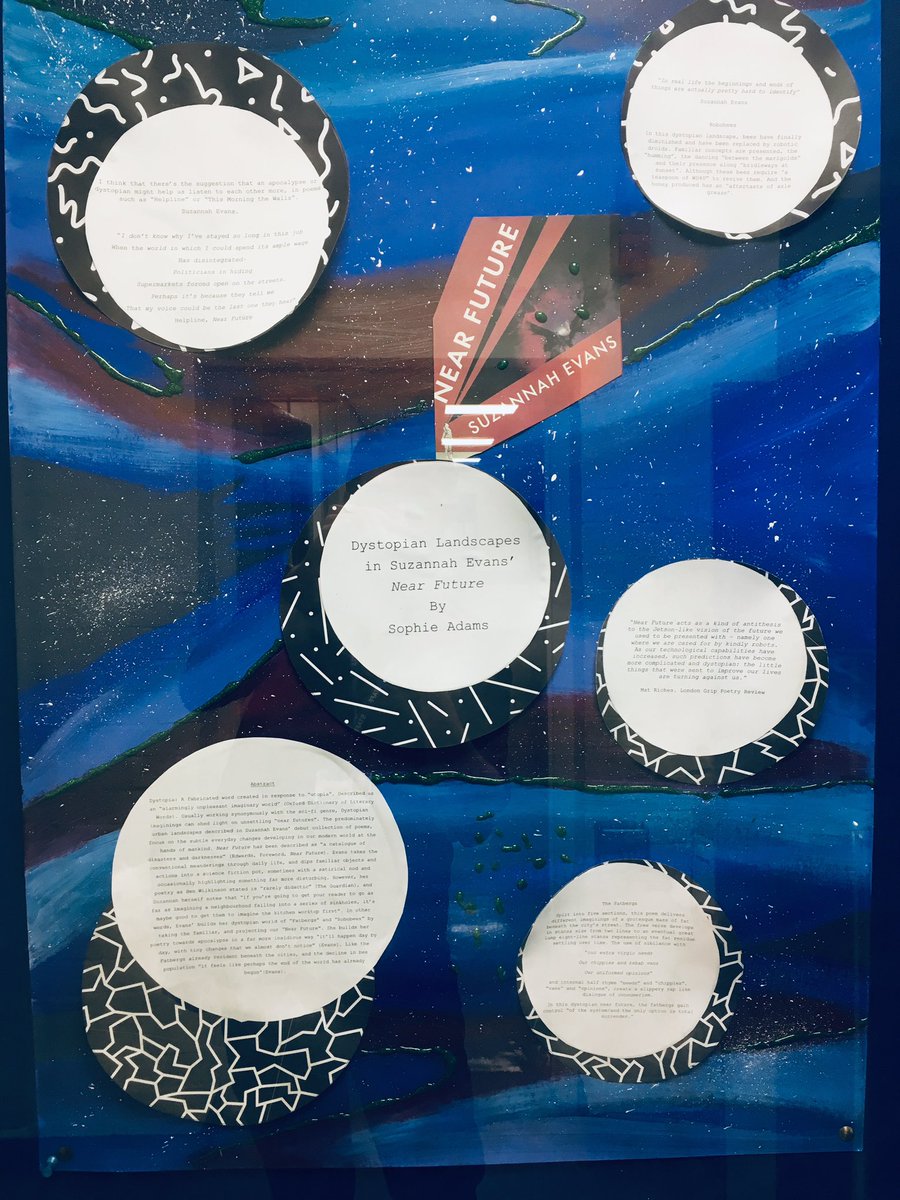
As it turns out, Sophie’s questions were hugely insightful, with every one of them making me turn back to my own book and look at it in a new way, and so I’ve asked her if she was happy for me to turn them into a blog post. She said yes. Sophie isn’t on Twitter but you can follow @CWatBolton for more of what the department gets up to. The image below is the final poster from her presentation (how space-age and cool!)
What role do you feel community plays in your fictional apocalypse? Is it important to forge connections to help one through difficult times, or is the “end” a very individual space?
I think there are many different apocalypses in the book, and they’re not all necessarily aiming for the same thing. But I do think that community is there in some of them. I think that there’s the suggestion that an apocalypse or dystopia might help us listen to each other more, in poems such as ‘Helpline’ or ‘This Morning the Walls’. Often the endings in this book help the people in those poems to see the relationships that are important to them. The apocalypses here often stand in for our own mortality, so perhaps that isn’t much of a surprise.
A lot of the dystopian scenarios in the book started life in something real, for example ‘This is England’s greenest City’ was inspired by the tree-felling in Sheffield, where I live. There were a lot of protests and action taken by residents to try and prevent the council’s contractors felling the trees. A lot of the things in the poem are quite far fetched – but some of them are true, and have happened. Community amongst residents, and the action groups they formed, was a vital part of ensuring that Sheffield kept its trees. But as conditions get worse for the speaker in this poem, they are seen as becoming more isolated, and more alone. Although there is something very individualistic about the more ‘survivalist’ or ‘prepper’ attitudes, there is also something about being connected to others that I’m sure will help us survive.
I’m interested in how the future may call for our cities and the way we live to be different, and I suppose the ways in which widening inequality between rich and poor may mean that some people suffer more than others. Poems like ‘The Plug-in-City’ in which a well-to-do community of individuals can literally pick up and move their lives to more hospitable places, with the implication that those outside the city may not be having an easy time of it at all.
Do you find there is a connection between Romanticism and the apocalyptic ideas you portray in your poems ?
This isn’t a connection that I’ve nurtured too much, and it’s maybe even something I have gently mocked in poems like ‘The Last Poet-in-Residence’ – the Romantic figure of the poet alone in a landscape that he writes about, but it is an apocalyptic landscape of increasing danger, and nobody is ever going to read the poems! I am interested in exploring the connection between the poet and nature, but have always thought the Romantic idea of nature as something ‘fitted to the mind’ rather than the other way around, rather reductive. Humans seeing nature as something separate from ourselves, or something to be mastered, rather than something we’re part of, is probably why we’re in the mess we’re in.
How do you want the minutiae to work within the vast spaces you create in your poetry?
I don’t think you can have a vast anything without minutiae. If you’re going to get your reader to go as far as imagining a neighbourhood falling into a series of sinkholes, it’s maybe good to get them to imagine the kitchen worktop first, or something like that. I don’t really believe that the end of the world will happen all at once. It’ll happen day by day, with tiny changes that we almost don’t notice, day after day of decisions that don’t feel like much. I think that feels much more apocalyptic than a thunderclap or the sun going out all at once. It feels like perhaps the end of the world has already begun and we don’t even know it. In real life the beginnings and ends of things are often pretty hard to identify.
 Suzannah Evans